The Star - How Tax Cheats Get Caught

Tuesday August 2, 2011

Comment by Kang Beng Hoe

THE term tax cheat used here refers to the determined tax evader and not to someone who made a good faith mistake due to the complexity of the tax law.

He is someone who sets himself up to evade tax either by not paying at all or regularly underpaying. He is unlikely to have kept books or records, or even if he did, they would likely be inadequate, or he would withhold them from the tax authorities.

Here the tax official is faced with the problem that actual undisclosed income cannot be proven directly. He will have to resort to indirect means to do so.

One of the most powerful tools that the tax official has on hand is the use of the net worth statement also known as capital statement.

The success of the net worth method is premised on the fact that income which has been hidden away will, over time, surface as assets in tangible forms such as landed property, stocks and shares, cars, jewellery etc. Why do you think the local tax office would keep tab of regular notifications from the land office and JPJ evidencing a taxpayer's acquisition of a property or a motor vehicle?

The reasoning behind the net worth approach is quite simple. When a person accumulates wealth in the course of a year, he either invests it in assets or spends it. If there is an increase of net worth over the year, there is the presumption that this represents taxable income.

This presumptive approach has been adopted in parts of many tax systems. Critics say that the approach is confiscatory in nature and is a denial of the basic right of a person to protection of property. The courts though have endorsed the net worth method on the reasonable argument that a person who has accumulated substantial wealth should be able to show where it came from, if it is not from his known income sources.

The basic net worth formula looks at a person's increase in net worth over a year. To this is added expenses, which are not tax deductible, including living expenses. The result is income for the year, which should have been reported. Compare this with what was reported and the taxman would have a figure, which represents understated income.

The use of this formula is repeated over a number of years so that the taxman will be able to determine the understatement of income over those years. The six-year time limit in our tax law will preclude looking beyond six years unless evidence of fraud is present.

An area of common dispute is the taxpayer's living expenses as these are added to the net worth formula.

It is not uncommon for the taxpayer to hold himself out to the tax official as a man of frugal habits until confronted with evidence of lavish spending. The tax official is empowered by case law to make estimates of a taxpayer's living expenses using all available evidence including third party verification.

The preparation of a net worth statement is laborious and time consuming. Expect detailed line-by-line examination of bank statements, financial statements to creditors and other relevant documents evidencing asset purchases or other spending. Safe deposit boxes are not safe hiding places as these could be sealed off pending examination of their contents.

Defences put up range from the typical to the bizarre:

Cash at start of the statement period had been claimed to have been hidden in mattresses, shoeboxes and garden sheds, etc.

Monies were borrowed from relatives, friends and business associates.

Assets were jointly owned by the spouse before the start of the enquiry period, or the taxpayer is the owner in name only and that the real owner may not be under investigation.

Net worth increases were due to gifts, inheritances, insurance proceeds and even gambling or lottery winnings.

The question often asked is whether offshore assets should feature in the net worth statement since offshore income is not taxable. The answer is yes unless it can be shown that the offshore funds were not funded from domestic taxable income.

It has been said that our tax system is founded on levels of trust. At one level, when we pay our taxes, we assume that our fellow citizens will pay theirs too. The tax cheat has thus betrayed this trust making us feel unfairly burdened. Effective enforcement by tax officials, using all available means, including the net worth method, is therefore crucial in any credible tax system.

It is also obvious to many that the net worth method could be used to reveal and prove illegal activities in areas other than tax evasion.

This is because the proceeds from such activities are often invested in visible assets.

When one hears the chorus “how can he afford it?” directed at a public official found flaunting his conspicuous acquisition, the public mind is showing its intuitive understanding of what it takes to show him up.

· Kang Beng Hoe is an executive director of Taxand Malaysia Sdn Bhd, a member firm of Taxand, the first global organisation of independent tax firms. The views expressed do not necessarily represent those of the firm. Readers should seek specific professional advice before acting on the views. Kang can be contacted at kbh@taxand.com.my

Wise ways to save on taxes - The Star

Sunday March 21, 2010
Wise ways to save on taxes
By ELAINE ANG and JOSEPH LOH
sunday@thestar.com.my

The tax man cometh again but before you file in your returns, look for ways to maximise your tax savings.

THE time for filing tax returns is upon us again and foremost on every taxpayer’s mind now is how to pay the least tax without being penalised – or even imprisoned – for tax avoidance.
So the million-dollar question is how can Malaysian taxpayers pay less tax?

KPMG tax partner Pauline Tam points us to some simple moves.

“Make an effort to be updated with the full list of tax exempt or partially tax exempt allowances or benefits, personal relief, deduction, rebates or tax incentives that we as individual taxpayers are entitled to.

“Start to recap what you spent in 2009 and compile the receipts for purchase of books, magazines, sports equipment, computer and course fees for a degree at Masters or Doctorate level and so forth that you could have chucked away in your drawers.

(Note : There is also the Housing Loan Interest relief as announced in the Mini Budget which was omitted here)
“If you have somehow forgotten what you spent in 2009, it’s never too late to start planning now for 2010,” she advises.

Peter Lim, a senior manager with a multinational company, has a shoebox full of receipts which he plans to sieve through in the coming weeks to offset against his taxable income.

“I aim to take advantage of all the tax reliefs that I am entitled to. My taxes always result in a big hole in my pocket as I tend to lose my receipts and am not updated on the latest incentives and reliefs.

“Hopefully it will result in lower taxes for me this time especially since the Government did not introduce many new incentives for the year of assessment (Y/A) 2009,” he says.

There are few changes in terms of tax incentives, reliefs and rebates for individual taxpayers for Y/A 2009 versus Y/A 2008.

The main changes consist of the reduction of the top marginal tax rate to 27% from 28%; increase in the rebate given to individual taxpayers whose chargeable income does not exceed RM35,000, to RM400 from RM350; and tax exemption on interest income from Syariah-compliant savings bonds issued by the Government.

The withholding tax rate on non-corporate investors including residents and non-residents for income from real estate investment trusts listed on Bursa Malaysia was reduced to 10% from 15%.

In addition, bonus and directors’ fees are to be taxed in the year such income are received.
Therefore, tips for individual taxpayers to pay less tax would definitely come in handy. (See: Important points to consider and Quick Tips chart)


Employers’ role
KPMG’s Tam says employers might wish to educate their employees on the types of reliefs and tax deductions that they are entitled to, as well as the types of records that employees should maintain to substantiate the claims.

“This would go a long way in assisting employees. The tax awareness programme could involve either inviting Inland Revenue Board (IRB) officials or their tax agents to conduct briefings on a yearly basis or whenever there are tax changes.

“The programme could also include guidance on how to e-file their tax returns and to have a better understanding of their rights and obligations under the tax laws,” she adds.

Employers should also consider the available tax exempt benefits and allowances when reviewing the annual remuneration package for their employees to reduce their financial burden.
However, these would have to be weighed against the additional cost and administrative tasks in implementing the benefits.

PricewaterhouseCoopers Taxation Services Sdn Bhd managing consultant Hilda Liow concurs.
“Malaysian employers are mostly quite receptive to employee tax incentives announced by the Government and do actively consider structuring their employees’ remuneration for tax effectiveness.

“However, the usual constraint is in ensuring that there is no increase of cost to the employer in implementing a tax efficient remuneration structure,” she says.

She stresses that Malaysian employers have to begin to appreciate the overall attractiveness of their employee remuneration and incentives programmes as an important tool for recruiting and retaining talent.

New incentives for Y/A 2010
Incentives that taxpayers should look out for this year are as follows.

Firstly, the top tax rate on chargeable income exceeding RM100,000 is 27% for Y/A 2009, with a reduction to 26% for Y/A 2010.

Secondly, personal relief will be increased from RM8,000 to RM9,000.

In addition, there are new tax reliefs like a tax relief of up to RM500 per year for broadband subscription fees from 2010 until 2012.

The relief for life insurance premiums/approved fund contributions would be increased to RM7,000 from RM6,000.

The additional RM1,000 is given solely to annuity scheme premium from insurance companies contracted with effect from Jan 1, 2010.

The Budget 2010 announcement also saw the unprecedented introduction of a flat reduced tax rate incentive on the employment income of a knowledge worker in a specified economic region (the knowledge worker, qualified activity and specified region must be approved by the Finance Minister).

“The employment income of a Malaysian and foreign knowledge worker residing in Iskandar Malaysia and working in qualifying activities will be taxed at a flat rate of 15%,” Liow explains.
“This incentive applies to knowledge workers applying for and commencing employment in Iskandar Malaysia between Oct 24, 2009 and Dec 31, 2015.”

However, the IRB has yet to issue guidelines on the definition of “knowledge workers” and neither has it provided clear guidelines as to the application process and the documentation to support the application with the Finance Ministry.

To sustain a progressive nation, Liow says the Government would need to enhance the competitiveness of individual taxes.

“There is still the 1% gap between the top personal tax rate of 26% (effective from Y/A 2010) and the corporate tax rate of 25% (effective from Y/A 2009).

“An eventual harmonisation of the top personal and corporate tax rates could provide a competitive advantage in attracting investment and providing greater flexibility for individuals in business to determine their business structure,” she adds.

According to Liow, it is also timely for the Government to expand green tax incentives to the individual consumer especially with the continued focus on green issues and the need for countries to work together to lower their carbon footprint and reduce gas emissions.

Currently, the only incentive enjoyed by an individual is the stamp duty exemption announced in Budget 2010 on the costs incurred to obtain the Green Building Index certificate by the first owner of a residential building.

“More incentives for the individual taxpayer could include residential energy efficient reliefs for energy efficient households, such as the usage of solar heating systems and circulating fans as well as fuel vehicle reliefs for the usage of personal hybrid vehicles,” Liow says.

Tam highlights that widening the income band in each income bracket for the respective progressive tax rates or granting more reliefs or deduction would have a substantial impact in easing the tax burden for individuals.

She reckons the Government could introduce parent relief in recognition of taxpayers supporting their aged and handicapped dependants with further parent relief if the taxpayer lived with the dependant.

“They can also allow taxpayers to claim the full amount of donations given to approved charitable organisations without any restriction. Currently, the deduction of donations is limited to 7% of aggregate income,” she says.

In addition, Tam says, the Government could consider reinstating the deduction of interest paid to finance the acquisition of real property as part of the incidental cost to the acquisition price for computing real property gains tax payable.

For a limited time only, Sunday Star with the assistance of PremierOne Tax Consultants Sdn Bhd. will answer questions from readers who want to know more about filing their tax returns. E-mail your queries to: taxsunday@thestar.com.my

Borang CP500

Many taxpayers received the Borang CP500 in 2010 requesting them to make instalment payments in 2010. This, it seems, is beacuse these taxpayers received other incomes other than employment (eg. rental, dividends, etc) and declared them in "Other Income" column in 2009's Borang B/BE.

Therefore, the instalments payments under CP500 is the tax for these income from 'other sources', which is crazy beacuse 'other income' received in 2008 may vary very differently from the amount received in 2009.

The Star carried a 'clarification' from the IRB on 23 Feb 2010, which raises more questions and does not clarify much actually.

Tuesday February 23, 2010
Get CP 500 notice cancelled if you don’t earn extra income

PETALING JAYA: If you receive a notice of instalment payment (CP 500) from the Inland Revenue Board, do not panic!

The notice, which states the amount, due date and number of instalments, is meant for taxpayers with earnings other than monthly salaries such as income from business and rentals as well as commissions from multi-level marketing or insurance.

Those with a fixed salary, but without other earnings, should go to the branch handling their income tax files to have the notice cancelled.

IRB public relations officer Masrun Maslin admitted that IRB had received many complaints from taxpayers without side income who were issued with such notices.

“Do not panic. If you do not have any other means of income other than your monthly salary, just go to the branch handling your file for the notice to be cancelled immediately,” he said.

However, he said taxpayers would still have to provide supporting documents such as the EA form to show that they did not have income other than their monthly salaries.

Masrun said taxpayers without side income were being issued with such notices due to possible errors in their income tax return forms. “For instance, they must have wrongly put dividends, bonuses or pensions in the other earnings column instead of the salary column.

“The system automatically captures the data on the other earnings and thus, the taxpayers will be issued the CP 500 notices.”

He said previously, the IRB would look at the list of those eligible for the tax liability on other earnings before issuing the notice.

A complainant who declined to be identified said he was upset upon receiving the notice.
He said he contacted the IRB branch handling his file and was advised to ignore it.

However, he was asked to call the branch again next month to check whether he would still have to settle the instalment payments.

“The officer told me that he had been receiving a lot of queries and complaints pertaining to the notice,” he added.

Titles In This Blog

LATEST !


Individual tax

Potongan Cukai Berjadual (PCB) / Schedular Tax Deduction (STD)

Real Property Gains Tax (RPGT)

Others


Q&As

The Malaysian newspapers sometimes run series of Q&As for Income Tax issues. They are compiled as follows :-


Feel free to put your comments here on other topics that might interest you or questions that you want answered.

Can RPGT be minimised ?

By POON YEW HOE

It may be possible by transferring properties to a company, but there are many pitfalls to consider

AT the recently concluded budget seminar of our firm, a major focus of the 650 attendees was the proposed real property gains tax (RPGT) of 5% to be imposed on disposals of property after Jan 1.

Resigned to the inevitability of the tax and the futility of objections, the ingenious ones posed the question to us on the possibility of tax minimisation by transferring their current properties to a company before Jan 1.

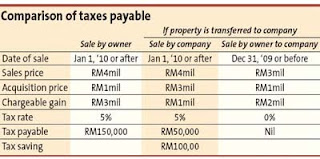
The plan calls for properties which were acquired many years ago at a cheap price (say RM1mil) to be transferred to a company controlled by them at the prevailing market price (say RM3mil).
The transfer will be effected before Jan 1, thus attracting no RPGT on the disposal.

In the future when the property is disposed off by the company, the company will only be taxed on the capital gain over and above the new cost of RM3mil.

If the disposal price by the company is RM4mil, the company will only pay tax on the capital gain of RM1mil (RM4mil less RM3mil) at the rate of 5%, thus resulting in RPGT of RM50,000.
A very ingenious idea indeed.

The comparison of taxes payable shows a tax saving of RM100,000 calculated as seen in the table.

Before anyone embarks on such a potentially lucrative move, one has to bear in mind many of the pitfalls, some of which are discussed below.

Date of disposal

For the purpose of this discussion, the term “chargeable assets” is used to refer to properties and other assets that can be caught under RPGT.

Chargeable assets include shares in real property companies which are companies that predominantly hold assets in the form of properties or shares in other real property companies.

Only chargeable assets disposed on Jan 1 or after will be assessed to RPGT. Those disposed of from April 1, 2007 to Dec 31, 2009 will not. A day is literally night and day for tax purposes!

But the term “disposal date” has a technical definition and it is not the date when the sales price is paid over as we usually consider a sale to be. In sales circles, as they say, a sale is not a sale until the money is collected!

However, for RPGT purposes, a sale is a sale on the day a written agreement is entered into.
Hence, the date that a sale and purchase agreement is entered into for the sale of a property is usually the date of disposal for RPGT purposes. But what if there is no written agreement?

The law provides that the date of disposal is the earlier of two dates – the date that the sales price is fully received or the date that the ownership is transferred. Disposals of this nature may have disposal dates being deferred to a later date, which may fall in the 5% taxable period!

Likewise, disposal dates may be deferred even much later if the sale is dependent on securing approvals from the “Government or an authority, or committee appointed by the Government” – for example, the state government, the Securities Commission (SC) or Foreign Investment Committee.

For these “conditional contracts” which are covered by Para 16 of Schedule 2 of the RPGT Act, the disposal date is when the last of the approvals is obtained.

If a sale and purchase agreement is signed in December 2009 that is subject to SC approval which is obtained in February 2010, the disposal will be treated as having taken place in 2010 and thus subject to the 5% RPGT!

Stamp duty on the transfer

Stamp duty is imposed on the documents for the transfer of title; for example, the memorandum of transfer for transfer of property.

The rates applicable are fairly steep for properties which range from 1% to 3% with the highest rate of 3% being applicable for transfer prices which exceed RM500,000.

Transfers of shares attract duty at the rate of RM3 for every RM1,000 of the transfer price or 0.3%.

However, to avoid stamp duty, one may wish to transfer the property without the transfer of title; for example, the owner holds the property in trust for the company.

What if no transfer of title is effected as in these circumstances? Will the issue of tax avoidance then arise? Perhaps.

Anti-tax avoidance in the RPGT Act

Section 25 of the RPGT Act contains the general anti-avoidance provisions which allow the tax authorities to disregard transactions, vary transactions or impose taxes that should have been imposed.

The law specifies that this right is available if the transactions had the effect of “altering the incidence of tax”, “relieving a person from tax liability” or “evading or avoiding any liability which would otherwise have been imposed”.

Besides these general anti-tax avoidance measures which are also found in the Income Tax Act to discourage income tax avoidance, Section 25 of the RPGT Act also provides for persons who provide loans to related parties; for example, Mr A providing loans to Company A which is owned by him.

The law provides that if Company A sells a property and the property was financed by a loan provided by Mr A, the disposal may be regarded as a disposal by Mr A and not by Company A.

However, the cost of acquisition to Mr A is the market value of the property when Company A acquired the property from Mr A. If Company A had acquired the property from Mr A at the true market value, this anti-tax avoidance provision of the RPGT Act should not pose any problem.

Previous rules by Ministry of Finance (MOF)

A few years ago, the Government had granted a similar tax free period from June 1, 2003 to May 31, 2004.

During that period, the MOF had issued some guidelines to curb the avoidance of RPGT by mandating that any disposal of property must be evidenced by a sales and purchase agreement which must be duly signed and stamped within the exemption period.

Sale of property to a company in exchange for shares .

Care should be taken if the property owner transfers a property to a company controlled by him in exchange for shares, or at least 75% in the form of shares. If the transfer is done this way, the shares may be considered to be chargeable assets.

In the future when these shares are sold, the gains will be subject to the RPGT of 5%. The cost of shares for RPGT purposes is not the par value of the shares but the price paid by the property owner for the property plus incidental expenses incurred by him on the acquisition; for example, legal fees.

As such, if Mr B transfers a piece of property acquired for RM1mil to his company (Company B) at market price of RM3mil in exchange for 3 million RM1 shares, and the shares are subsequently sold for RM4mil, the gains on disposal are calculated at RM3mil which is RM4mil sales price less the acquisition price to Mr B of RM1mil.

Indirectly therefore, Mr B is taxed on his full capital gains and not merely on the gains made by Company B owned by him.

RPGT or income tax?

Another aspect which has deep implications is whether the disposer had held the property as stock-in-trade or as a long term investment.

If held as stock-in-trade, the gains on disposal will attract income tax whereas if held as a long term investment, the gains will attract RPGT.

Some property investments which are disposed as part of a quick sale, or as a single isolated transaction in circumstances which give it a cloak of “adventure in the nature of trade”, could be caught under income tax.

Due to space constraints, we are unable to elaborate on this issue. If these disposals are caught under income tax, what then is the advantage of disposing the properties before Jan 1 if the disposer has to pay income tax at 25% on the gains upfront?

The obstacles can be quite challenging as seen above and careful navigation of the tax law is necessary. But I am sure good tax advisers will find a way out of the conundrum!

· Poon Yew Hoe is a partner of Horwath.

Understanding Real Property Gains Tax (RPGT)

Understanding your tax exposure
By Dr CHOONG KWAI FATT

Exemption order an interim measure to a complete RPGT system

IN Malaysia , real property gains tax (RPGT) is imposed with the intention to curb property speculations. It is imposed on the gains on disposal of Malaysian landed properties and the rate varies from 5% to 30% depends on the holding period.
With effect from April 1, 2007, the Government decided to exempt RPGT in view of the economic slowdown and it was aimed at assisting property developers in disposing of their houses, and spearheading the economic progress.

Prime Minister Datuk Seri Najib Tun Razak, who is also Finance Minister, on Oct 23, however, reintroduced RPGT to put in place a fair administration of taxes.

In a nutshell, an equitable system will now be in place as income tax are imposed on income derived by any person in Malaysia while RPGT, on capital gains on disposal of landed properties. There will not be any loss of revenue to the Government.

In the Budget 2010 speech, the Government’s intention was clear. It is to ensure that the Malaysian tax system is equitable and continue to be able to generate revenue for development purposes. In line with this, the Government proposed that a tax of 5% be imposed on gains from the disposal of real property from Jan 1 2010. Any agreements signed between now till Dec 31 remains RPGT exempted.

Finance Minister II Datuk Seri Ahmad Husni Mohamad Hanadzlah then, exercising his power under section 9(3) of the Real Property Gains Tax Act 1976 (RPGTA), gazetted Real Property Gains Tax (Exemption) Order 2009 which will take effect from Jan 1, 2010.

A fixed RPGT rate of 5% on gains from property gains is achieved through the application of this exemption order.

Malaysian individuals are accorded tax exemption of 10% of the chargeable gain (CG) from the computation of RPGT3. Thus, this would effectively mean that they will be paying less than 5% of RPGT rate while companies continue to pay 5%.

The RPGT Exemption Order exempts any person from the application of Schedule 5 of the RPGTA on the payment of tax on the CG arising from any disposal of assets on or after Jan 1, subject to the condition that the amount of CG exempted shall be determined in accordance with the following formula: A/B x C where:

A = Tax on CG at the appropriate tax rate reduced by the Tax on CG at 5%;
B = Tax on CG at the appropriate tax rate;
C = Amount of CG

Effectively, the exemption formula can be simplified as follows:
Chargeable gain x (Appropriate rate – 5%) / Appropriate rate

The appropriate tax rate to be applied on this exemption order depends on the holding period of the property which is summarised as perTable A.

Illustration: Malaysian citizen individuals

Chia Lat acquired a condominium in Bangsar for RM500,000 on Jan 1, 2008. On March 31, 2010 he decides to dispose the property for RM780,000. The RPGT to be paid by him would be as per Table B.

Illustration: Companies

Using the same example as above, and assuming the taxpayer is a Sdn Bhd, the RPGT payable would be as per Table C.

Mathematical confusion

The mathematical formula stipulated in the RPGT exemption basically restores to the fact that the RPGT is 5% on the CG. This is the mathematical equation:
Assuming the appropriate tax rate is y and CG is x, then the RPGT payable after the RPGT exemption would be :

[x – x(y - 5%)/y ] y =xy – xy + 5% x
= 5% of x

The Government has stated that the purpose of the RPGT is to have a fair administration of taxes. Thus the exemption is an interim measure to begin with RPGT of 5% taxes. In years to come, once the exemption order is revoked, RPGT payable would revert to the original position, ranging from 30% to 5%, depending on the holding period.

Policy reform: Currently, taxpayers are only required to keep accounting records for seven years under the law. It may not be feasible to impose 5% on the chargeable gain on gains derived from holding periods more than seven years. This would mean tax payers are required to keep their accounting records for an indefinite time to justify cost attributable to the acquisition.

It is therefore suggested that the Government impose 2% on selling price instead of holding periods exceeding seven years or as in the past, exempt these gains from RPGT. After all, the underlying purpose of RPGT is to curb speculation of properties rather than tax collection.

Moving forward, the Government may likely further align the taxes on landed transactions to be equitable with the income tax system. Therefore, it is crucial that the rakyat understand the Government’s overall objectives and appreciate that this exemption order is an interim measure to prepare the country for a complete restoration of the RPGT system when the time comes.

Once the country’s economy is paced and sustaining desired growth, this exemption may likely to be revoked and property gains will be back causing gains will be taxed at the appropriate rate.
Till then, this exemption order will continue to allow us to enjoy most of our short-term trading gains from real property transactions.

● Dr Choong Kwai Fatt is deputy dean, Research and Development, Faculty of Business and Accountancy, University of Malaya .

RPGT only for sales within 5 years of purchase

The following is an extract of a report in The Star newspaper on 24 December 2009.

PUTRAJAYA: The real property gains tax (RPGT) announced during the 2010 Budget will now only apply to property sold less than five years from its purchase, Datuk Seri Najib Tun Razak said.

The Prime Minister said the 5% tax would now only be imposed on property sold within five years of the date of purchase.

He said the decision would cause the Government to lose about RM200mil in revenue, adding the move was made following appeals from the Federation of Chinese Associations of Malaysia (Hua Zong) and the business sector.

“This was also decided upon as the Government wants to see a stronger growth in the property sector next year. We are willing to forgo a substantial amount of revenue so that the sector can expand and grow.

“The property sector has shown signs of improvement but we feel that it requires further impetus so that it can continue to grow from strength to strength.

Q&A with Deloitte Malaysia on 2010 Budget

Deloitte Malaysia 's Q&A on Budget 2010
by Financial Daily on Tuesday, 27 October 2009 03:40

KUALA LUMPUR: Following the tabling of Budget 2010 last Friday, Deloitte Malaysia worked together with The Edge Financial Daily to enlighten readers on how the various proposals would impact tax payers and consumers. The following are the answers provided by Janice Tan and Lee Chong Hoo of Deloitte Malaysia based on queries sent in by our readers.

Question 1: What is the impact on a worker earning, say, RM5,000 per month pursuant to Budget 2010?

A: He would not benefit from the proposed one percentage point reduction in the personal income tax rate from 27% to 26% as his chargeable income does not exceed RM100,000.

However, he would be entitled to claim the following additional/new tax reliefs proposed:-
• additional personal relief of RM1,000 (an increase from RM8,000 to RM9,000);
• additional relief of RM1,000 for premium paid on annuity scheme from insurance companies (please refer to further details in our answer to question 2 below);
• new relief on broadband subscription fee paid of up to RM500 per year for years 2010 to 2012.

Q2: How does the proposed additional relief of RM1,000 for premium paid on annuity scheme work and what annuity scheme will it encompass?

A: The additional relief of RM1,000 is in respect of premium paid on annuity scheme from insurance companies contracted from Jan 1, 2010 or additional premium paid on existing annuity scheme from Jan 1, 2010.

This is on top of the existing relief for premiums paid on life insurance or annuity scheme and contributions to the Employees Provident Fund (EPF) of RM6,000.

Where the premium paid on the new annuity scheme or the additional premium paid on existing scheme exceeds RM1,000, the excess can be claimed against any unutilised amount for the existing relief of RM6,000, subject to a cap of RM7,000 for the aggregate amount claimed.

The annuity scheme for the purposes of the above relief under Section 49(1) of the Income Tax Act 1967 (ITA) is an annuity scheme contracted for with an insurance company for securing on death a deferred annuity and not the existing annuity purchased through EPF Annuity Scheme. Currently, a separate relief of RM1,000 is given for the premium paid on the EPF Annuity Scheme under Section 49(1C) of the ITA.

Q3: I understand that Real Property Gains Tax (RPGT) will be reinstated from Jan 1, 2010. Is the 5% tax rate as announced in the budget a fixed rate regardless of the holding period of the properties? Will this just apply to an individual?

A: Notwithstanding the proposals in the Finance Bill, the Ministry of Finance has confirmed that a 5% rate of RPGT irrespective of the holding period and category of tax payers, ie whether individuals or companies, will be introduced through a Ministerial Exemption Order effective Jan 1, 2010.

Q4: I have an apartment under the joint names of my son and myself. I wish to change the ownership in the apartment to either be:-
a) jointly owned by my daughter and myself, or
b) solely owned by my daughter.
Will the above proposed transfers be subject to RPGT based on the Budget 2010 proposals?

A: The transfer of ownership from yourself to your daughter under (b) will be regarded as a gift between parent and child and thus will be exempted from RPGT.

However, the above exemption by way of gift does not cover the transfer of ownership from your son to your daughter. Your son may choose to exercise the once-in-a-lifetime exemption from RPGT for disposal of private residence.

Q5: What will be my obligations if I were to acquire a property after Jan 1, 2010 for a total consideration of, say, RM500,000?

A: You would need to withhold the lower of the amount of money consideration or 2% of the total consideration and remit the sum to the Inland Revenue Board (IRB) within 60 days from the date of disposal. Assuming the total consideration of RM500,000 consists wholly of cash, the amount required to be withheld and remitted would be RM10,000. In addition, you would also be required to submit a return on acquisition of chargeable asset under the existing requirement of the RPGT Act 1976.

Q6: Will my obligation be different if my purchase consideration is partly in cash, say, RM5,000 and the balance is paid by way of shares?

A: The amount required to be withheld and remitted to the IRB will be reduced to the whole amount of the money consideration of RM5,000 and not 2% of the total consideration.

Q7: What will happen if I do not fulfil my obligations as an acquirer under the RPGT Act?

A: Failure to comply with the above withholding requirement would result in a 10% penalty to be imposed on the acquirer and the withholding due plus the penalty would be regarded as a debt due from the acquirer to the government.

Q8: If I sell two properties, one at a profit of RM50,000 and another at a loss of RM15,000 in the same year, what is my chargeable gain?

A: It is proposed under Budget 2010 that any allowable loss arising from a disposal of a chargeable asset would be deducted against any chargeable gain arising from subsequent disposals. As such, your chargeable gain would be RM35,000 after deducting the allowable loss of RM15,000.

Q9: Currently I have two credit cards, one from Citibank and the other from CIMB. I am the principal card holder while my wife and two children are secondary card holders from both banks. I heard that I will be imposed a service tax on such cards effective from Jan 1, 2010. How will it affect me?

A: Effective from Jan 1, 2010, service tax of RM50 and RM25 would be imposed annually for each principal and secondary card respectively. As such, you would be subject to service tax totalling RM250 annually [(RM50 x 2) + (RM25 x 3 x 2)] for the above principal and secondary cards

Q10: I understand that tax incentives for health tourism would be enhanced whereby the exemption rate of 50% on the value of increased exports would be increased to 100% subject to 70% of the statutory income for each year of assessment? How does the exemption work and what would constitute exports for the purposes of the above exemption?

A: The amount of income to be exempted is computed based on the increase in the value of qualifying services exported for two consecutive basis periods.
Assuming the values of services qualifying for exemption are RM100,000 and RM200,000 for Year 1 and Year 2 respectively, the value of increased exports would be RM100,000 ie (RM200,000 — RM100,000).

As such, the amount of income to be exempted for the above example under the Budget 2010 proposal would be RM100,000 instead of RM50,000 based on the existing 50% exemption rate.
The above amount exempted would be allowed as a deduction against the person’s statutory business income (SI) in arriving at the chargeable income but is restricted to 70% of the SI for that year of assessment. Any unutilised amount can be carried forward to be deducted against future statutory income. Normally, statutory business income is computed by deducting allowable expenses and capital allowances from the gross income of the business.

To qualify for the aforesaid exemption, the healthcare services must be provided to the following foreign clients in Malaysia :

a) A company, a partnership, an organisation or a cooperative society incorporated or registered outside Malaysia ;
b) Non-Malaysian citizens who do not hold Malaysian work permits; or
c) Malaysian citizens who are non-residents living abroad.

For the purposes of the enhanced incentive, foreign clients would now exclude:

a) A non-Malaysian citizen that participates in Malaysia My Second Home Programme and his dependents;
b) A non-Malaysian citizen holding a Malaysian student pass and his dependents;
c) A non-Malaysian citizen holding a Malaysian work permit and his dependents; or
d) Malaysian citizens who are non-residents living abroad and his dependents.

However, healthcare services providers who are currently providing services to foreign clients who are excluded under the enhanced incentive can continue to enjoy the existing incentives.

This article appeared in The Edge Financial Daily, October 27, 2009.

Budget 2010 - What is there for individual taxpayers

The Budget 2010 announced on 23 October 2009 has a few changes to individual taxpayers. The Budget Speech can be viewed here with Appendices here.

The sections in the budget speech affecting individual tax payers are :-

24 & 25 IRB will use the MyKad number as a single reference number when dealing with taxpayers, hence doing away with Income Tax Reference Numbers starting with SG or OG.

40 Individual taxpayers will be given tax relief of up to RM500 per year for broadband subscription fees from 2010 to 2012.

88 Re-introduction of Real Property Gains Tax (RPGT) of 5% for gains arising from the disposal of properties from 1 January 2010.

89 Each principal credit card will be charged a service tax of RM50 per year and each supplementary credit card will be charged a service tax of RM25 per year with effect from 1 January 2010.

101 With effect from the Year of Assessment 2010, the maximum rate of individual income tax is reduced by 1% to 26%.

102 Personal Relief increased from RM8,000 to RM9,000

103 & 104 Income tax rate for 'knowledge workers approved by the Ministry of Finance', both Malaysians and foreigners who applied and commenced employment in Iskandar Malaysia between 24 October 2009 and 31 December 2015 be fixed at 15%

117 EPF contributors will be allowed to use Account 2 of their current and future EPF savings to obtain financing, subject to EPF's guidelines, to purchase a residential property. This scheme will be launched in January 2010.

122 & 123 The government will establish a 1Malaysia Retirement Scheme to be managed by the EPF for those retired and self-employed to contribute as savings for their retirement.

124 Employees' contribution to EPF will be reverted to 11% from the current 8%, voluntarily from January 2010 and mandatorily from January 2011.

125 Increase of the EPF/Life Insurance Personal Relief limit from RM6,000 to RM7,000 from the Year of Assessment 2010. However, the increase of RM1,000 is only for annuity premiums paid from 1 January 2010.

The Appendices concerned are Appendix 3, 14, 15, 16 & 17.

Special Telephone Lines for Budget 2010 Queries

The Prime Minister cun Finance Minister 1 is going to table the Budget 2010 on 23 October 2009.

As usual, the Inland Revenue Board has set up special telephone lines to enable the public to call and have their queries answered on anything announced in the Budget.

The dedicated telephone lines are :-

1. 03-6201 3037
2. 03-6201 3046
3. 03-6201 3048
4. 03-6201 3052
5. 03-6201 3054
6. 03-6201 3058
7. 03-6201 3059
8. 03-6201 3061

From the Media Statement in the website of the IRB, the telephone lines are open on 23 October 2009 from 7.00 pm to 10.00 p.m. only.

Suggestions for Budget 2010

The Prime Minister cum Finance Minister 1 has invited the public to give suggestions to be considered in the coming 2010 budget to be tabled on 23 October 2009.

The suggestions can be input at http://www.1malaysia.com.my/

I have sent in 4 suggestions on 12 October 2009 and they appeared in the website here. As the pages changes as and when more people give their suf=ggestions, I copied it here as follows :-

gtchye: Increase Personal Reliefs for Income Tax

The personal relief for income tax was increased from RM5,000 to RM8,000 in 1999. There has been no increase for 10 years. With the increasing cost of living, the personal relief should be increased to a minimum of RM10,000. (Sec 46(1)(a) of the Income Tax Act 1967)

Spouse and children's reliefs should also be increased to reflect the increased cost of a sustaining a family. (Sec 47 & 48 of the Income Tax Act 1967)

Life insurance premiums and employees' EPF paid should be separated and each given a limit of RM6,000. Insurance policies are getting too expensive and to encourage savings, premiums paid should be entitled to its own relief instead of combining it with EPF. (Sec 49 of the Income Tax Act 1967)

Relief for medical expenses for parents has not been revised since it was increased from the year of assessment 1996. This should be expanded to include medical expenses for children. (Sec 46(1)(c) of the Income Tax Act 1967)

Let's see if any of these are taken up in the Budget.

Tax residence status of an individual

In determining the income tax rate (hence the amount of income tax payable) of an individual, it is important to first determine if he/she is a tax resident under the Malaysian Income Tax Act, 1967 (ITA).

Many people seem to have the view that if an individual stays in Malaysia for 182 days or more, he/she is a tax resident under the ITA. Anything shorter than that, then the person is a non-resident and is subject to non-resident tax rate, i.e. a flat rate of 27% (Year of Assessment 2008).

This is far from true ! Section 7 of the ITA clearly provides more than one situations when an individual taxpayer is considered a tax resident.

Section 7 of the Malaysian Income Tax Act says,

7. (1) For the purposes of this Act, an individual is resident in Malaysia for the basis year for a particular year of assessment if-

(a) he is in Malaysia in that basis year for a period or periods amounting in all to one hundred and eighty-two days or more;

(b) he is in Malaysia in that basis year for a period of less than one hundred and eighty-two days and that period is linked by or to another period of one hundred and eighty-two or more consecutive days (hereinafter referred to in this paragraph as such period) throughout which he is in Malaysia in the basis year for the year of assessment immediately preceding that particular year of assessment or in that basis year for the year of assessment immediately following that particular year of assessment: Provided that any temporary absence from Malaysia -

(i) connected with his service in Malaysia and owing to service matters or attending conferences or seminars or study abroad;

(ii) owing to ill-health involving himself or a member of his immediate family; and

(iii) in respect of social visits not exceeding fourteen days in the aggregate, shall be taken to form part of such period or that period, as the case may be, if he is in Malaysia immediately prior to and after that temporary absence;

(c) he is in Malaysia in that basis year for a period or periods amounting in all to ninety days or more, having been with respect to each of any three of the basis years for the four years of assessment immediately preceding that particular year of assessment either-

(i) resident in Malaysia within the meaning of this Act for the basis year in question; or

(ii) in Malaysia for a period or periods amounting in all to ninety days or more in the basis year in question; or

(d) he is resident in Malaysia within the meaning of this Act for the basis year for the year of assessment following that particular year of assessment, having been so resident for each of the basis years for the three years of assessment immediately preceding that particular year of assessment.

(1A) For the purposes of subsection (1), an individual shall be deemed to be in Malaysia for a day if he is present in Malaysia for part or parts of that day and in ascertaining the period for which he is in Malaysia during any year, any day (within subsection (1)(a) and (c)) for which he is in Malaysia shall be taken into account whether or not that day forms part of a continuous period of days during which he is in Malaysia.

The wordings are rather lengthy.

In layman’s terms, it simply means that an individual is considered a Malaysian Tax Resident if he/she is :-

Sec 7(a) in Malaysia for 182 days or more in a calendar year ;

Sec 7(b) in Malaysia less than 182 days and this period is linked to last year or next year of 182 days or more ;

Sec 7(c) in Malaysia for 90 days or more and 3 out of 4 years before, either
( i) is a tax resident ; or
( ii) is Malaysia for 90 days or more

Sec 7(d) 3 years before he/she was tax resident and next year also tax resident.

In order not to re-invent the wheel, I found a good write up and explanation in a website here.

Per diem - Clarification finally

The IRB has finally issued the Third Addendum to Public Ruling No. 1/2006 on 29 July 2009 (view here) to clarify that per diem received is exempted, thus officially reversing their Second Addendum issued on 25 February 2009.

So what happen to all those taxpayers who included per diem received in 2008 in their tax returns ?

Understanding Income Tax issues are already complicated enough for the ordinary taxpayers, the IRB should stop being so frickle minded and make a public ruling without considering the effects on taxpayers and the to reverse it with another public ruling, especially after the tax filing deadline.

Why the fuss with PCB deductions 2009 ?

PCB deductions used to be a simple tax collection process imposed by the IRB. How much is your income for a month, follow the table provided by the IRB, follow the amount of estimated income tax payable and that amount is deducted from your monthly salary and remitted to the IRB.

At the end of the year, you receive the Borang EA from your employer and you calculate how much actual tax you have to pay, taking into account the relieves you have, claims, exemptions, rebates, etc and you fill up the Borang BE, send to the IRB and pay the difference between your actual tax and the total PCB deducted for the year.

If your total PCB deducted for the year is higher, then you get a refund from the IRB.

However, things get really complicated since January 2009. The PCB table is changed, calculation of PCB become totally impossible without a payroll software, TP1, TP2, etc.


Why has the PCB turned into something so complicated ?

The reason is this: The Malaysia IRB wishes to follow its counterpart is Singapore in implementing a system where all salaried employees will not have to file their tax returns (Borang BE) in future.

Refer to the Singapore’s Straits Times report on 7 May 2009 below.

http://www.straitstimes.com/Breaking%2BNews/Singapore/Story/STIStory_373767.html

The system will make the PCB a Final Tax, as opposed to an Estimated Tax as at now.

We are in the first year that the IRB is gearing towards this system. That is why there are so many teething problems and adjustments needed. How long more before the IRB can fully implement the Final Tax via PCB system is yet to be seen.

Rebates to be Deducted Monthly ?

The following article appeared in The Star newspaper on 6 August 2009.

Thursday August 6, 2009
Taxpayers can now have rebates deducted monthly

KUALA LUMPUR: The Schedular Tax Deduction (STD) scheme has been reviewed to enable the deduction of rebates and relief to be done on a monthly basis, Inland Revenue Board chief executive officer Datuk Hasmah Abdullah said.

Previously, she said rebates and relief were only taken into account when taxpayers claimed for it when they filed their income tax returns annually.

“By deducting on a monthly basis, we can have real-time payment of taxes due,” she said, adding that this was in line with the agency’s policy to provide the best service to the public by emphasising on accuracy of information.

------------------------------------------------------------------------------------
If I refer to the Borang TP1 now, there are already columns to state your rebates for :-

1. Zakat paid (Column D1)
2. Fees/Levy for employment permits paid (Column D2)

The only other rebates not stated is the personal rebates for those taxpayers with Chargeable Income of RM35,000 or less.

However, this rebate would have been taken into account when the employers input the data from Borang TP1 into their payroll system. The payroll system would have incorporated the personal rebates into their calculation to generate a new PCB deduction amount.

This is yet another confusing statement made by the IRB and picked up by the media without any substantial impact on the employees.

New PCB System ?

The Star newspaper published the following article on 10 July 2009.

No other information is available after the publication. A check in the LHDN’s website also does not show any new PCB system or table. Borang TP1 has been in use since January 2009.
It does not look like there is a ‘new’ tax deduction system from July. This announcement is confusing employees and employers and should be ignored.

Published: Friday July 10, 2009 MYT 9:07:00 PM
New tax deduction system from July
By SARBAN SINGH

PORT DICKSON: A new schedular tax deduction system from this month will eliminate the need for employees to pay an additional lump sum at the year-end to make up for the shortfall in monthly deductions.
Inland Revenue Board (IRB) chief executive officer Datuk Hasmah Adullah said that under the current system implemented in 2004, the board had on many occasions taken a big cut of the individual’s bonus to make up for the shortfall.
“We had cases where an employee’s entire bonus would go to the IRB (to make up for the shortfall). We do not want to do this any more as it is unfair to the taxpayer.
“It is better for us to make higher deductions every month. This is a better arrangement,” she said, adding that under new system, the taxpayer would have paid up almost all his dues by the end of the year.
She added that the new system would also allow for employees to submit their claims for rebates every month, along with a range of new reliefs.
Previously, the taxpayer was allowed to claim relief for himself, his spouse, their children, his Employees Provident Fund and insurance contributions, and zakat payment (if any), and claim other reliefs only when filing his returns at the end of the assessment year.
Under the new system, Hasmah said an employee can submit claims for rebates such as parents’ medical bills, purchase of a computer, tertiary education fees, medical check-ups, and book and sports equipment purchases to his employer every month using the PCB/TP1 form.
“When this is done, the tax to be paid for that particular month will be reduced automatically. This would practically be a real-time tax payment system.
“We want the taxpayer to benefit straightaway rather then wait till the end of the year,” she said.
She said under the new system, the employee could make monthly claims for 17 other reliefs announced in Budget 2009.
The employee, she added, would not have to submit receipts for the claims to the employer.
Among the new reliefs announced are for travelling allowance, petrol claims, parking fees, food allowance, caretaker fee, maternity and traditional medicine treatment (ayurvedic, acupuncture, etc) and subscription to broadband services.
She said taxpayers could submit their claims for rebates monthly, quarterly or twice a year.
Hasmah said employers who needed assistance on the workings of the new structure could enter the board’s website at www.hasil.gov.my and look for the schedular tax deduction (PCB) calculator icon.

Use EPF to Reduce Your Income Tax

The EPF (Employees Provident Fund) is a compulsory contribution for Malaysian employees and employers. Although foreigners are not required to contribute EPF, they can opt to contribute at the same rate as Malaysians. While the employees’ portion of contribution can be deducted as a relief from income for tax calculations, the employers’ portion is a tax-free income to the employees. It is this part of income that we want to concentrate in.

Employees have 8% (option to increase to 11%) of their salaries deducted and contribute to the EPF whereas employers pay 12%. Employers are allowed to contribute up to 7% more than the statutory rate of 12%, i.e. up to 19% under the Income Tax Act for employers to be able to deduct these contributions from the employers' taxable income. If an employer contributes more than 7% above the statutory rate, the excess is not allowed as a deduction when calculating the employers' income tax.

An employee can arrange for his/her employer to contribute 19% to EPF by lowering his/her salary. For example,

Original salary RM10,000 a month, Employer’s EPF (12%) RM1,200.
Cost of hiring to employer = RM10,000 + RM1,200 = RM11,200


The employee can ask his/her employer to consider paying less basic salary but increase the employer's contribution to EPF as follows :-


Adjusted salary RM9,412 a month, Employer’s EPF (19%) RM1,788
Cost of hiring to employer = RM9,412 + RM1,788 = RM11,200

So there is no difference to the employer, but for the employee, his/her taxable income is RM588 (RM10,000 – RM9,412) less a month, which is RM7,056 a year. If his/her tax bracket is at 27%, the tax saving would be RM1,905.12 a year !

Of course, the employee’s take home pay at the end will be less as well but the difference is credited into the employee's EPF account, which belongs to the employee anyway. The additional contribution to the EPF can be withdrawn for purchasing a house when needed, or as additional retirement fund when he/she retires.

For foreigners, they will be able to withdraw all the money they have in the EPF when they leave Malaysia, together with all earned dividends, tax-free.

Potongan Cukai Berjadual (PCB) / Schedular Tax Deduction (STD) in Malaysia

What is PCB/STD in Malaysia ? How does it work ? What is the minimum salary to be caught under the PCB net ?

Among the top searches that came to this site is on “PCB/STD”. This posting explains the workings of PCB/STD in Malaysia and how the calculations are computed.

PCB/STD is based on the commonly known “Pay-As-You-Earn” (PAYE) principal practiced in many countries. Before STD/PCB was introduced in Malaysia, taxpayers were subjected to “preceding year assessment” basis, meaning you declare this year, what you earned last year, and you pay tax this year for last year’s income.

For example, you earn salary of RM100,000 in the whole year in 2008. You only submit your income in Form BE in April 2009. As a result, you only pay your income tax in 2009 for your 2008 income.

This practice posed problems for IRB’s collection department mainly due to taxpayers who already spent their money earned in 2008 and they failed to set aside money to pay for their tax.

The PCB/STD was introduced to collect income tax as and when they are earned by taxpayers. Therefore, the IRB has directed employers to deduct a certain amount out of the monthly salaries of taxpayers to pay for their income tax. Hence, Pay-As-You-Earn (PAYE).

With PCB/STD, taxpayers are no longer paying income tax for preceding year’s income. The tax deducted is from the month’s income is to pay for income tax for that month’s salary.

PCB/STD is not a final tax. As income tax is collected based on an employee’s salary, taking into account his/her marital status, whether spouse working or not and number of children, it is only an estimate. What the STD/PCB fails to take into account are other things such as,

- whether or not you have life, medical or education insurance
- claims for purchase of personal computer
- claims for medical expenses for self, spouse or parents
- claims for purchase of books
- claims for purchase of sports equipments
- whether you have other income such as dividends or rental, etc

Therefore, the PCB/STD paid in a year can almost never be exactly the actual income tax payable.

When the final tax is calculated during the submission of Borang BE in April the following year, then only we will know what the actual tax payable is. If the actual tax is more than the accumulated PCB/STD for the year, the difference will have to be settled not later than 30 April the following year. If the accumulated PCB/STD is more than the actual tax, the IRB will repay the taxpayer.

What is the minimum salary a taxpayer earns before he/she is subject to PCB/STD ?

That depends on whether he/she is married, spouse working or not and number of children he/she has. A single person and a married person with 4 kids may earn the same amount of salary but the single person may be subject to PCB/STD but the married person may not.

Similarly, a married man whose wife is working and has 1 child may be subject to different PCB/STD amount compared to a married man whose wife is not working and has 3 kids.

To see if you are subject to PCB/STD, please refer to the table in the IRB’s website.

To calculate the PCB/STD, one must determine his/her category in the table. If an employee is single or married and his/her spouse is working, then he/she falls under Category 1. If he/she is married and his/her spouse is not working, then Category 2.If he/she is married and his/her spouse is working, then Category 3.

Under categories 2 and 3, there is K, K1, K2, K3, etc. This refers to number of children the employee has. K means no children, K1 – 1 child, K2 – 2 children, etc.

After determining which column he/she falls under, next is a take his/her monthly gross salary less employee’s portion of EPF (limited to RM500). Use the net amount to find the band of salaries in the first column. Then, follow the row to the correct category to get the amount of PCB/STD applicable.


A detailed example (though rather complicated) is given in the IRB's website here.

So you missed the Income Tax Form BE submission deadline, what now ?

The deadline for submission of Income Tax Form BE for 2008 was 30 April 2009. There may be many who missed the deadline for various reasons.

What happens next ? What are the penalties ?

Let us examine the Income Tax Act (ITA) to see what penalties are there and what the IRB’s practice is.

Section 112(1) of the ITA states that if you default in submitting the Form B or BE before the deadline ‘without reasonable excuse’, you are liable to a fine not exceeding RM1,000 or 6 months jail or both ‘on conviction’.

In practice, the IRB seldom use this Section to charge you (unless you are a big fish). This is because in order for them to apply this Section, they have to charge you in court and get a conviction. Note that there is still an escape clause “without reasonable excuse”. You may have a reasonable excuse and in order to get a conviction from the court, it may take years.

Section 112(3) says that if no prosecution in instituted, then the IRB may require you to pay a penalty equal to ‘three times the amount of tax payable’ (before any set-off, repayment or relief). If you have paid the penalty under Section 112(3), then you shall not be charged under Section 112(1) again.

So in practice, the IRB will usually fine you under Section 112(3). For normal salaried workers who file in Form BE, they usually impose a fine of RM50 for the first offence. If you are still late next year, they may impose a fine of RM100. The next year, RM150 etc.

It is interesting to note that Section 112(3) allows the IRB to impose a fine only if you are taxable. Note the wordings ‘three times the amount of tax payable’. If your tax payable is ‘0’, three times ‘0’ is still ‘0’.

So if your ‘Tax payable’ under item E9 of the Form BE is ‘0’, then you need not worry this year as the IRB will not be able to impose a fine on you. However, the IRB will take note that this is your first offence. If you are late again next year, they may fine you RM100 right away if you have tax payable.

The Star - 17/04/09

MORE TIPS ON LESSENING YOUR INCOME TAX BURDEN


This is the final of a three-part ACCA Easy Guide to Tax Filing for Employees, which looks at income tax threshold, child relief and penalties

FOR YA2008, employees need to make a minimum annual salary of RM26,804 before triggering income tax.

Married couples should ensure that the higher-earning spouse claims child relief to lessen the tax burden. Remember to abide by income tax regulations to avoid heavy penalties.
Income Tax Threshold

For YA 2008, an employee is required to file Form BE by or before April 30 through electronic filing or actual submission of the tax return form to the Pusat Pemprosesan at Pandan Indah, Cheras.

The employee is entitled to the following tax reliefs:

Employees must make a minimum salary of RM26,804 to be liable for income tax for YA 2008.

Example 1: An individual with only EPF contributions as relief.

An employee may not be required to pay tax on employment income exceeding RM26,804 if said individual employee incurred other tax reliefs on books, medical check-ups or life insurance premiums.
Example 2: Assuming an individual with a salary of RM30,062 has tax reliefs other than EPF contributions, he may not be liable for income tax. His tax payable is:
An employee earning annual salary exceeding RM30,062 may also not be liable to pay income tax if he incurred the following expenses:

(a) Medical expenses for parents RM5,000
(b) Medical or educational insurance for taxpayer, spouse, child RM 3,000
(c) Basic supporting equipment for taxpayer, spouse, child, parents RM3,000

An employee with an existing SG income tax reference number may need to file in a nil return on Form BE even though his annual salary for YA 2008 is below RM30,062.
Child Relief

Married couples can claim child relief for maintaining any child during the calendar year 2008 whether the child is their own, a stepchild, or a legally adopted child.

The amount of child relief is:

18-years-old or less (RM1,000); above 18 and studying in university or college (RM4,000).
Child relief is given for any number of children who are not married.

Child relief for disabled children is RM5,000.

An additional RM4,000 is granted if the disabled child is studying in university or college.
To minimise tax payable, child relief should be claimed by either spouse who has the highest taxable income.

Example: Li and Choo have three children below 18 years. Li’s total income is RM90,000 and Choo’s RM60,000 for YA 2008. The child relief entitlement is RM1,000 x 3 = RM3,000. (see charts above)

Penalties

The Income Tax Act 1967 imposes various penalties for non-compliance. These include:

(a) Non-submission of return

Return Form BE for YA 2008 needs to be submitted by or before Apr 30, failing which taxpayers incur a:

(i) Penalty that is 3 times of tax
(ii) Fine between RM300 to RM2,000

In practice, the tax authorities impose 2%-20% on the tax payable as the penalty instead of the statutory formula of 300%.

(b) Non-payment of final tax

The employer deducts the employee’s monthly tax which is paid to IRB on the 10th of every month. The difference between the actual tax and the total tax deducted by the employer must be paid to IRB on / before Apr 30. Failure to pay the final tax on Apr 30 will result in a late payment penalty of 10% being imposed.

An additional 5% will be imposed if the final tax or penalty is still not paid by June 30 (60 days after Apr 30)

(c) Not keeping sufficient records

Under the self assessment system, an employee is required to keep sufficient records on his tax affairs for seven years. Only the tax return Form BE is submitted to IRB by or before Apr 30.

These records comprise a copy of Form BE, salary slips, Form EA (Statement of Employment Income), and credit card statements in relation to petrol claims, travelling, parking, and toll charges incurred in relation to official duties.

Failure to maintain sufficient records is an offence and the penalty will be:

(i) A fine between RM300 to RM10,000 or
(ii) Imprisonment ≤ 1 year.